
Data Monetization Without Selling Your Data
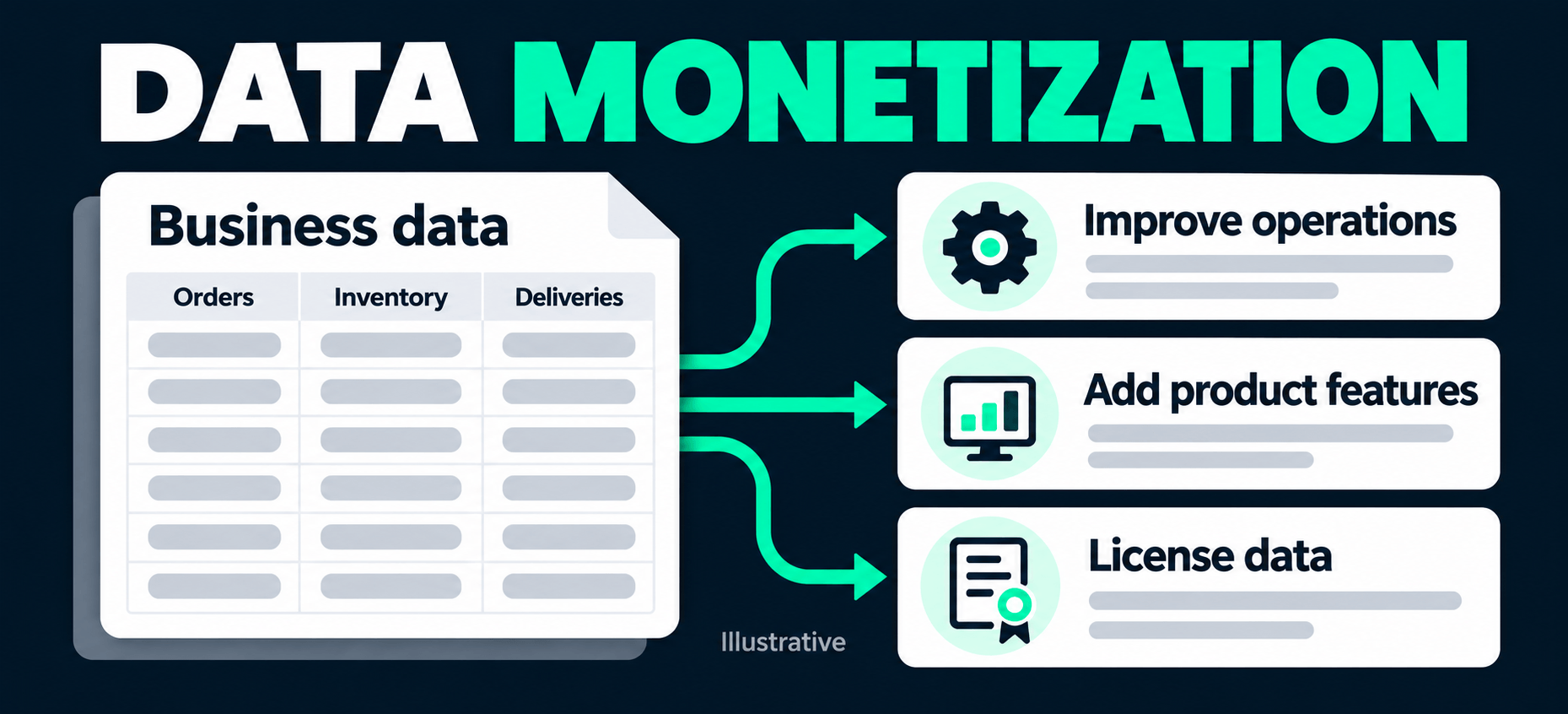
Ask a leadership team what data monetization means and many will describe selling customer data. With no obvious buyer, the idea gets shelved, and the value in the company's own operations goes untouched. You don't need a buyer to start: data makes money in three ways, two of them stay inside the company, and you can test one with a single dataset before you commit a budget.
The confusion is common. When MIT researchers interviewed 58 executives at 34 companies in 2014, they collected about 60 definitions (opens in new tab) of data monetization.
MIT's Center for Information Systems Research (MIT CISR) has since settled on three routes: improving your own operations, wrapping data into products customers buy from you, and selling information products. Below you'll find what each one looks like, which fits your company, and how to run a first test.
The short version: You don't have to sell your data to make money from it. For many companies the first return comes from cheaper operations or a more valuable product, and neither needs a buyer. It counts only when the benefit becomes money: lower spend or higher sales. Test one dataset against a baseline and judge it net of cost.
What does data monetization mean?
Data monetization is turning data into financial returns, directly or indirectly. Direct means someone pays for data, insights, or an information product. Indirect means data makes your business cheaper or faster to run, or makes your products worth more. Both count, as long as the benefit ends up as money on the books.
MIT CISR defines it as "the direct and indirect conversion of data into financial returns" in its overview of data research (opens in new tab). The word "indirect" is the one that changes the picture. A report that now takes half the time to produce is data monetization, provided the saved time turns into money somewhere.
That condition matters more than it sounds. In its 2023 explainer (opens in new tab), MIT CISR describes improving as a two-step process: first the work becomes more efficient, then the organization converts that benefit into financial value. Skip the second step and you have a nicer workflow, not a return.
What are the three ways data makes money?
Improving uses data to run your own operations better, cheaper, or faster. Wrapping adds data-driven features to a product you sell, so customers value it more. Selling turns data into an information product that other companies pay for. Each route makes money in a different place and needs different groundwork.
Improving. The money appears in your own costs and output. MIT CISR's explainer describes how Microsoft cut the time its financial analysts spent gathering data by 30% within 15 months, then moved that time into working with sales partners, which increased sales. It also describes an airline that checks weather forecasts, predicts delays, and rebooks passengers automatically, which reduces overtime pay and customer refunds.
Wrapping. The money comes through the price or sales of an existing product. MIT CISR defines wrapping (opens in new tab) as "the act of amplifying the customer value of a product by adding analytics-based features and experiences." Its study of Cochlear (opens in new tab), the hearing implant maker, describes a sound processor that recognizes the listening environment, such as a crowded street or a quiet room, and adjusts its settings automatically. Another feature tracks how long a child goes without sound, called a "coil-off" event, and gives parents and caregivers feedback on how well the child is adapting. Customers still buy the device. The data makes it worth more to them.
Selling. The money comes from other companies paying for information. Walmart sells access to Walmart Luminate (opens in new tab), its data analytics product suite for merchants and suppliers, covering shopper behavior, channel performance, and customer perception. In May 2024, Walmart said 90% of its largest suppliers had signed up for a Luminate Charter subscription. According to MIT CISR (opens in new tab), Walmart gives suppliers a basic data package free and charges for deeper insights.
| Route | How it makes money | What you need first |
|---|---|---|
| Improving | Lower costs or more output in your own work | A measured baseline and a team ready to work differently |
| Wrapping | Higher prices, more sales, or both | Customers who would value insight from their own use |
| Selling | Revenue from other companies | Clear rights to share the data and buyers with a repeat need |
Which route should your company start with?
For most companies, improving is the right first step. It needs no buyer, the results land in your own costs or output, and a mistake stays inside the company. Wrapping makes sense when customers use your product daily. Selling fits when you hold data that is hard to find elsewhere and you have the rights to share it.
MIT CISR's 2024 survey of 349 organizations (opens in new tab) shows how far the first two routes can go. MIT measures impact as the extent to which an organization's data initiatives help it realize its strategic business outcomes. High-impact organizations following what MIT calls a customer focus strategy, which combines improving and wrapping, attributed an average of 20.4% of their revenue to data monetization. Low-impact organizations with the same strategy averaged 4.7%.
Selling can pay even more, but it asks more of you. High-impact organizations running an information business strategy, which combines wrapping and selling, attributed an average of 38.1% of their revenue to data monetization. Selling at that level takes clear rights, a reliable way to deliver data, and support for the people who buy it.
The survey also shows that returns track impact, not budget size. The high-impact customer focus group spent less on data on average ($38 million) than the low-impact group ($41 million), yet earned far more from it ($177 million against $27 million). A bigger data budget, on its own, does not produce a bigger return.
| Your situation | Best first route | Why it fits |
|---|---|---|
| Costly, repetitive work runs on data | Improving | Savings land in your own numbers |
| Customers rely on your product daily | Wrapping | Their usage can become a feature they value |
| You hold data that is hard to find elsewhere | Selling | Other companies may pay for access |
| You aren't sure yet | Improving | Cheapest to test, and no buyer is needed |
How do you test one route with a single dataset?
Pick one dataset, one use, and one outcome you can measure in money. Record a baseline before anything changes, make one change, and decide in advance what result would justify going further. Then judge the outcome net of cost. A small result you can prove beats a large one you can't.
- Choose the dataset. Look for a named user, a use that repeats, a clear owner, and data you can prepare in weeks rather than quarters.
- Check your rights first. Check what your contracts, customer consents, and privacy obligations allow for this specific use. A rights problem can stop a project no matter how good the data is.
- Measure the baseline. Hours, cost, error rate, or revenue, recorded before anything changes.
- Make one change. Automate a report, add a feature, or offer a pilot customer a sample.
- Turn the benefit into money. Saved hours count only when they cut overtime, contractor spend, or hiring, or move to work that earns revenue.
- Decide. Scale, adjust, or stop, using the threshold you set at the start.
Here is a hypothetical example. A mid-size retailer's finance team automates its monthly store-performance report using cleaned sales and store-traffic data, and saves 500 staff hours a year. At an assumed loaded cost of $60 an hour (salary plus benefits and overhead), that is $30,000 of time. Building the automation costs $8,000 and running it costs $2,000 a year, so the first-year net is $20,000.
That $20,000 becomes real money only if the team puts those hours to use, the way Microsoft's analysts shifted their time to sales partners. If the hours disappear into other busywork, the company has spent $10,000 and saved nothing. Converting the benefit is the second step MIT describes, so plan it before you start.
When does selling your data make sense?
Selling makes sense when four things line up: you hold data that is hard to find elsewhere, buyers need it again and again, you have clear rights to share it, and you can support customers after the sale. If any one of those is missing, improving or wrapping will usually pay off sooner.
Rights deserve the most care. Data about people, or data you received from partners under contract, often comes with limits on who else can see it. Settle those limits before you talk to a single buyer.
Price comes next. Before you name a figure, know what the dataset is worth and why. Our guide to finding out what your data is worth explains what drives that number, and our overview of data valuation methods compares the ways to calculate it. You will also need a way to reach buyers, whether through direct deals or a shared platform. Our guides to data marketplaces and data exchanges and choosing a data monetization platform cover those options.
Datavault AI's tools help with both questions. DataScore rates a dataset's quality and risk, and DataValue estimates its economic value. Together they show which datasets are fit to build on, which deserve investment, and which a buyer might want. If you decide to sell, Datavault's Information Data Exchange® (opens in new tab) is where you can list and exchange datasets.
Do you need to sell your data to make money from it?
No. Selling is one of three ways data makes money, and for most companies it isn't the place to start. Begin where the payoff is closest: a process that runs on data and costs too much, or a product customers use constantly. Prove one result net of cost, then decide whether wrapping or selling comes next.
Before your next budget review, list the three datasets your teams use most. For each one, note what one change would save or earn. A saving points to improving. A feature customers would pay for points to wrapping. A steady stream of requests from other companies points to selling.
If you want a second view on that list, Datavault AI can show you how DataScore and DataValue work and what the Information Data Exchange offers when you're ready to sell.
Request a Datavault demo (opens in new tab)
FAQs
Can data make money without being sold?
Yes. Many companies start by using data to run their own operations more cheaply, or to make the products they sell more valuable. Neither needs a buyer, and both count as data monetization once the benefit turns into lower cost or higher revenue.
What is data wrapping?
Data wrapping means adding analytics-based features to a product you sell, so customers value it more. A hearing implant that adjusts itself to a noisy street or a quiet room, or a dashboard that shows customers their own usage, are both examples. The money comes from a higher price, more sales, or both.
Is data monetization the same as tokenization?
No. Data monetization is the broad goal of turning data into financial returns. Tokenization is one possible method, representing an asset or an access right as a digital token. Many data monetization programs never use it.
Date
October 29, 2026
Category
Technology
 Back to Media & Insights