
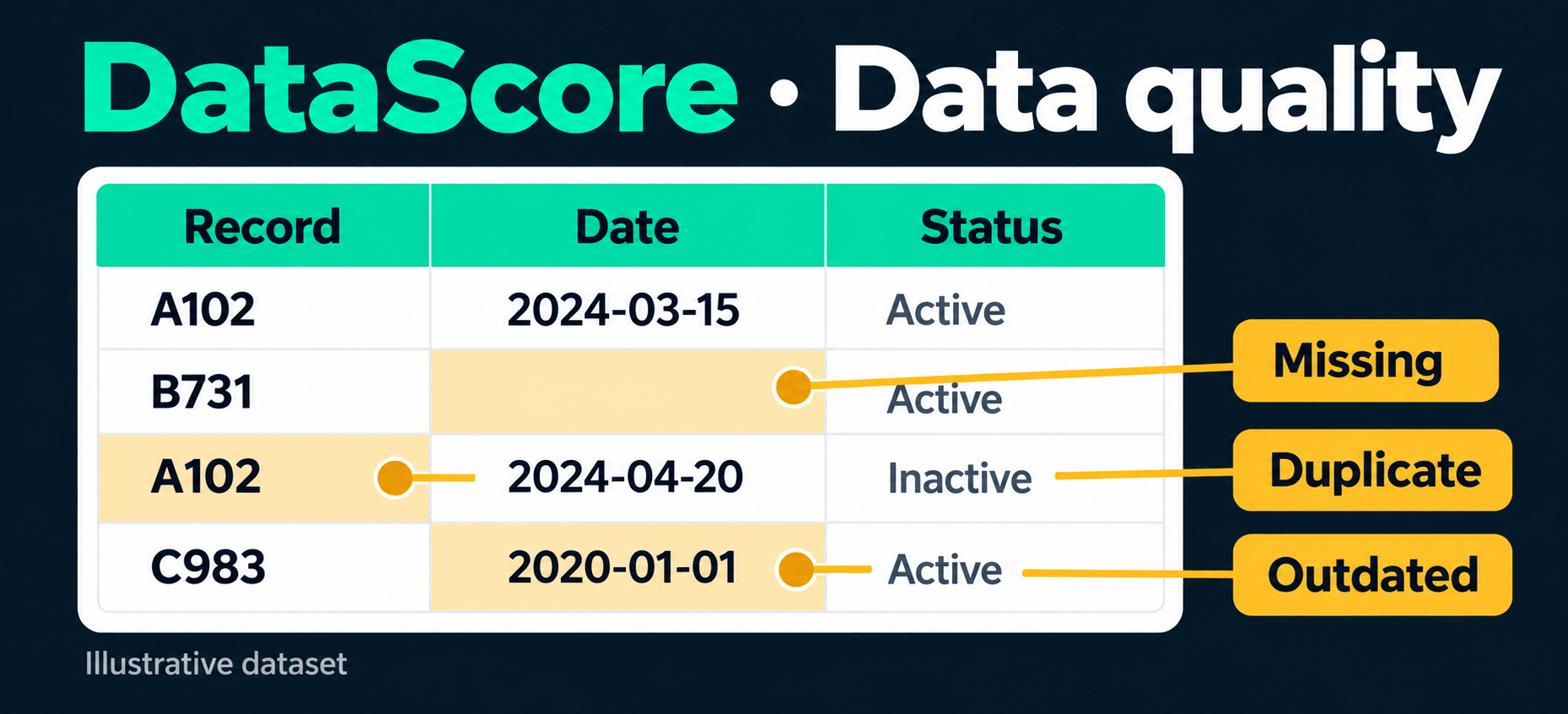
Data Quality Assessment: Is Your Data Good Enough?
Before a team trains a model on a dataset, builds a dashboard on it, or licenses it to a buyer, someone should know how many of its records are right. In many companies, nobody has checked. You can get a first answer in an afternoon with a simple sample test, then decide what to fix, what to use, and when a fuller DataScore assessment is worth it.
In a 2017 study published in Harvard Business Review (opens in new tab), 75 executives each checked 100 records created by their own departments. On average, 47% of newly created records had at least one critical error. Only 3% of the scores counted as acceptable, a bar the researchers set at 97 or more clean records out of 100 in their follow-up paper in Business Horizons (opens in new tab).
Datavault AI's DataScore adds a standardized view on top of a sample like that. It runs on IBM watsonx.ai, IBM's platform for building and running AI models, and gives your data, risk, and business teams one result to decide from while the decision is still cheap to change.
The short version: Check a dataset against the job you need it for before you build on it, license it, or train AI with it. A 100-record sample shows how many records are clean. Datavault AI's DataScore, with IBM watsonx.ai embedded, then scores the dataset's quality, trust, and compliance, and a free trial runs it on one of yours.
What does "good enough" data mean?
Good enough always means good enough for a specific job. The same table can be fine for a monthly dashboard and wrong for training a model or selling to a buyer. Quality is measured along a handful of dimensions, and the job decides how much each one matters.
IBM's overview of data quality (opens in new tab) names seven of them: completeness, uniqueness, validity, timeliness, accuracy, consistency, and fitness for purpose. IBM describes the last one as making sure the data meets a business need, which is why it ties the others together.
Each dimension becomes a plain question, with a cost if you skip it:
| Quality question | What goes wrong if you skip it | What to check |
|---|---|---|
| Is anything missing? | Gaps skew totals and models | Share of empty required fields |
| Is anything duplicated? | Customers and sales get counted twice | Matching rule and duplicate rate |
| Do values follow the rules? | Bad formats break pipelines and joins | Formats, ranges, and allowed values |
| Is it recent enough? | Decisions run on an old picture | Last refresh date against the decision |
| Is it correct? | Confident answers that are wrong | A sample checked against a trusted source |
| Does it agree across systems? | Two reports give two answers | The same fact in two tables |
| Is it right for this job? | Fine for a dashboard, wrong for a model | The use case it was checked against |
The last row changes the answers to all the others. A customer list last refreshed five years ago may be fine for spotting long-term trends and useless to a buyer who wants to reach today's customers.
Why does bad data cost so much more when you find it late?
Because other work gets built on top of it. Reports, forecasts, models, and contracts all inherit the flaw, so a fix late in the process means redoing everything downstream. Early, the same problem is a correction to one table. Late, it can mean a retrained model or a renegotiated deal.
In a 2017 analysis for MIT Sloan Management Review (opens in new tab), data quality expert Thomas Redman estimated that bad data costs most companies 15% to 25% of revenue. Much of that cost stays out of sight. People spend their days correcting errors and working around them, in what Redman calls "hidden data factories."
AI raises the stakes. IBM's overview makes the point with the old rule of "garbage in, garbage out": a model that learns to predict or classify from bad data will produce inaccurate results. The model may still look confident, which makes the errors harder to spot.
Licensing data adds one more risk. Take a hypothetical equipment maker that licenses three years of machine-sensor readings to a maintenance-software firm. If the buyer's checks turn up thousands of duplicate readings during due diligence, the price goes back on the table, and so does the maker's credibility.
How can you check a dataset before you rely on it?
Start small and specific. Name the job the data must do, pull a sample of recent records, and check each one against the quality dimensions that matter for that job. Count how many records pass. That rough number tells you whether to proceed, fix first, or get a fuller assessment.
The researchers behind the 2017 study call this exercise the Friday afternoon measurement. Managers took 100 records their departments had created, marked the obvious errors in each, and counted the ones with no errors. The share that came through clean works as a simple data quality score, and by the researchers' standard, a score below 97 is not acceptable.
To run it on your own data:
- Name the job. A dashboard, a forecasting model, a licensing deal. Write it down, because the job decides what "good" means.
- Pull 100 records. Use recent ones from the system the job will draw on, not a cleaned-up extract.
- Mark errors by type. Missing fields, duplicates, broken formats, stale dates, wrong values, and conflicts with another system.
- Count the clean records. If 60 of your 100 records have no errors, your rough quality rate is 60%.
- Write down what you found and who owns it. A problem with no owner rarely gets fixed.
If the dataset is headed for an AI project, our AI data readiness checklist goes further on what to confirm first.
A spot check like this is fast and revealing, and it has limits. It covers a sample, it depends on who does the checking, and it gives your risk team notes rather than a consistent result to review. That is the gap a DataScore assessment fills.
What does a DataScore assessment give you?
A standardized read on a dataset's condition. DataScore® analyzes multiple attributes of your submitted dataset and returns a credibility and quality score, with IBM watsonx.ai embedded. On its trial page, Datavault describes the score as being "in terms your risk and compliance teams recognize," so data, risk, and business teams can work from one result.
In practice, it tells you whether a dataset is fit for analytics or monetization, according to Datavault's technology overview (opens in new tab), and it looks at data quality and compliance with rules such as GDPR and CCPA, according to IBM's announcement (opens in new tab).
Compared with the spot check above:
| What you need | Your spot check | DataScore assessment |
|---|---|---|
| Coverage | A sample of records | Your submitted dataset |
| How results are produced | Depends on who checked | Standardized scoring |
| Compliance view | Your team's judgment | Quality, trust, and compliance scored |
| What your risk team receives | Notes and a rough rate | A credibility and quality score |
| AI inside | None | IBM watsonx.ai |
Keep your spot check anyway. The scoring weights are proprietary and not part of the trial, and your sample costs only an afternoon, so it gives you an independent read beside the assessment. If the two point different ways, look closer before anyone relies on the data.
What should you do with the results?
Turn every finding into a decision. Fix the problems that matter for the job at the source system rather than in a copy, and give each one an owner. Check again once the fixes are in. Then decide: use the data, keep it internal, or take the next step and find out what it is worth.
A practical order:
- Rank findings by their effect on the job. A missing field that a model depends on outranks a typo in a notes column.
- Fix at the source. Corrections made in a downstream copy disappear the next time the data refreshes.
- Give each fix an owner and a due date. Track it until it closes.
- Bring privacy and legal in on any compliance concern. The decision to share or license stays with them.
- Check again after the fixes. Rerun your sample, or ask Datavault about a follow-up assessment.
DataScore assesses data. Correcting it is work your team does in its own systems.
Once a dataset is in good shape, the natural next question is what it is worth. DataValue, DataScore's companion tool, answers that with an algorithmic valuation report, and our DataValue guide explains how to read one. For the ways clean data earns money, see what data monetization is.
How can you get a DataScore assessment on your own data?
Through Datavault's free trial. Send a short request, and someone on the Datavault AI partner team checks the fit before anything else happens. Both sides sign a mutual NDA before you share data. The trial puts one dataset through DataScore and DataValue, and teams on IBM Cloud or watsonx get the most from it.
Have four things ready: the dataset, the use case it serves, a champion on your side, and the date you need to decide by. The assessment runs in a Datavault-managed environment, so confirm your data policy allows sharing this dataset with a vendor under NDA. Our guide to the Datavault AI and IBM partnership covers what IBM adds.
What to do before your next data decision
You can't know whether data is good enough until you check it against the job. Take the dataset behind your next decision, pull 100 recent records, and count the clean ones. Below 97, by the researchers' standard, the data needs work before anyone relies on it, and that is the point to get a fuller assessment.
DataScore gives you that fuller picture on one dataset, with IBM watsonx.ai inside, and the trial pairs it with a DataValue estimate of what the same data could be worth.
Request a DataScore and DataValue trial (opens in new tab)
FAQs
What are the main dimensions of data quality?
IBM lists seven: completeness, uniqueness, validity, timeliness, accuracy, consistency, and fitness for purpose. The last one decides how much the others matter, because data that is fine for one job can be wrong for another.
Does a DataScore assessment fix the data?
No. DataScore assesses a dataset's quality, trust, and compliance and returns a score. Fixing what it finds is up to your team, in your own source systems.
Can data be good enough for one use and not another?
Yes. A sales table that works for a monthly dashboard may be too incomplete to train a forecasting model. Always judge quality against the specific job the data has to do.
Date
October 31, 2026
Category
Technology
 Back to Media & Insights