
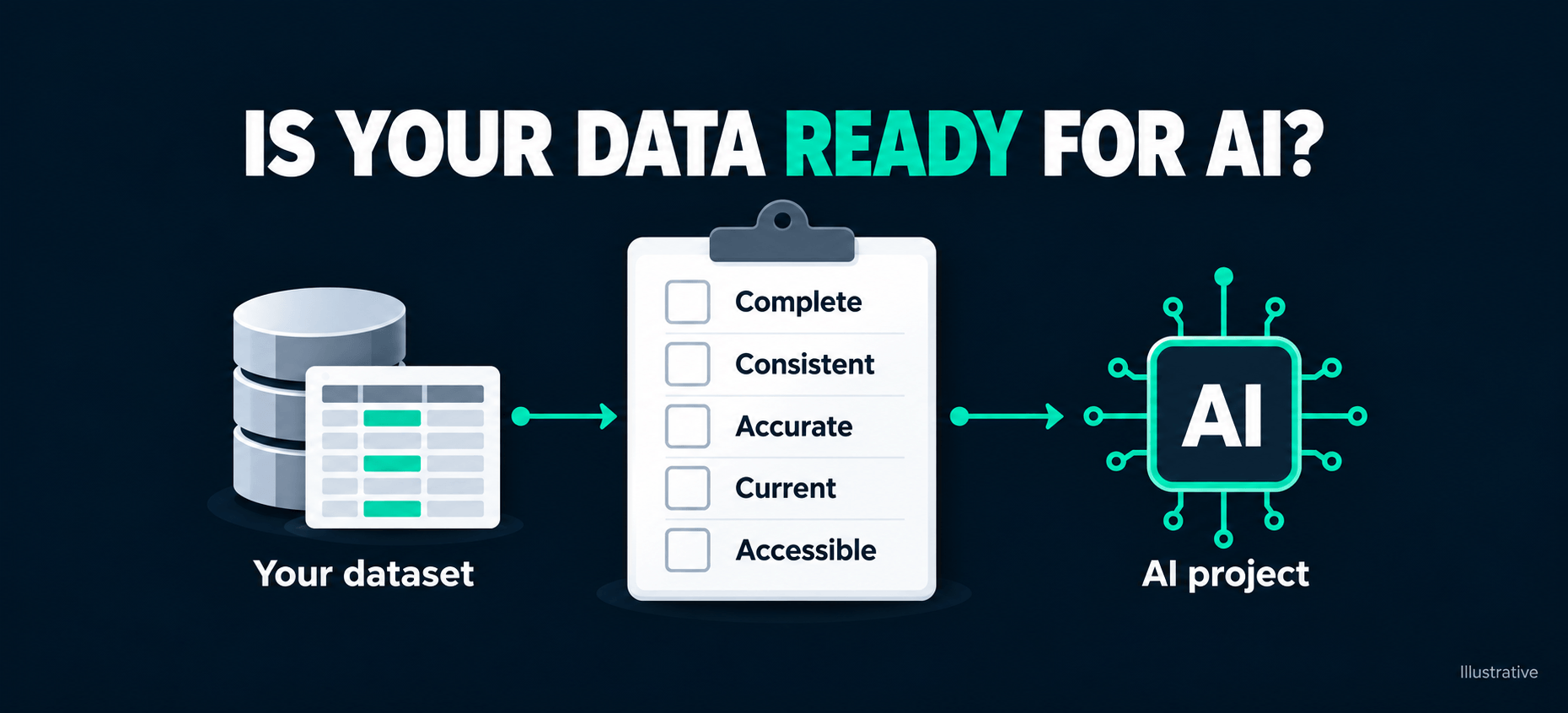
Data Readiness for AI: Is Your Data Ready for the Job?
Many AI pilots follow the same arc. The demo works on a clean sample, the budget gets approved, and then the project meets the full dataset and stalls. This checklist helps you find out, before that happens, whether a dataset is ready for the specific use case you have in mind, what to fix first, and who should fix it.
The gap between pilot and production is wide. In IBM's 2025 CEO Study (opens in new tab), a survey of 2,000 chief executives, CEOs said only 25% of their AI initiatives over the past three years delivered the expected return, and only 16% scaled enterprise-wide. IBM's guide to AI-ready data (opens in new tab) ties that record to data, saying the success or failure of AI initiatives depends on how well organizations manage and prepare it.
Readiness belongs to a use case, not to a dataset. The same table of lab results can be ready for one model and wrong for the next.
The short version: A dataset is ready for AI only for a specific use case. Check eight things: purpose, rights, coverage, condition, labels, freshness, access, and documentation. Give each one evidence, an owner, and a status of ready, needs work, or blocked. Clear rights and purpose problems first. A DataScore assessment gives the condition row a standardized score for one dataset.
What does it mean for data to be ready for AI?
Ready means fit for a named purpose. IBM defines AI-ready data as high-quality, accessible and trusted information that organizations can confidently use for AI training and initiatives. The real test is narrower: can this data support this model, for this decision, under the rules that apply to it? Clean data in a good warehouse can still fail.
The NIST AI Risk Management Framework (opens in new tab) builds the same logic into its guidance. It asks teams to document a system's intended purposes and the settings where it will be deployed (MAP 1.1). It also asks them to document considerations about how data was collected and selected, such as its availability, representativeness, and suitability (MAP 2.3). Suitability only means something against a purpose.
A hypothetical example shows why. Take a pharmaceutical company with five years of manufacturing-quality records: batch test results, deviation reports, and supplier lot details.
- For a model that predicts which batches will fail release testing, the records may be ready as they are: complete, current, and covering every plant.
- For a model built with a contract manufacturing partner, the same records may be blocked if supply agreements limit who can see supplier lot data.
- For a model that finds the root causes of deviations, they may need work, because deviation reports are free text with inconsistent categories, so there is little structured cause for the model to learn from.
So the checklist starts with the use case, not with the data.
What should an AI data readiness checklist cover?
Eight questions cover most use cases: what the model is for, whether you may use the data for it, whether the data covers the cases the model will meet, what condition it is in, whether reliable labels exist, whether it is current, whether watsonx can reach it, and whether anyone can explain where it came from.
Each question needs evidence, not opinion, and a named owner who can produce that evidence. Use this table as a working template:
| Question | Evidence that answers it | Owner |
|---|---|---|
| Purpose: what decision will the model support, and what counts as good enough? | A one-page use-case brief with a success measure | Business sponsor |
| Rights: may we use this data for this purpose? | Consent terms, contracts, licenses, privacy review | Legal or privacy lead |
| Coverage: does the data include the cases the model will see? | Record counts by segment, period, and region | Data owner |
| Condition: is it complete, accurate, consistent, and free of duplicates? | A quality profile or a DataScore assessment | Data engineering |
| Labels: are there reliable answers to learn from or test against? | A labeled sample checked by an expert | Domain expert |
| Freshness: is it current, and will it stay current? | Last-updated dates and a refresh schedule | Data owner |
| Access: can watsonx reach it securely at the volume needed? | A working connection and approved access controls | Platform architect |
| Documentation: can someone explain where it came from and how it changed? | Data dictionary, lineage, and source notes | Data steward |
Three rows deserve extra care. Rights is easy to skip, because the data already sits inside the company and feels like yours to use. NIST's framework notes that training data may be subject to copyright and that keeping track of its provenance supports transparency and accountability.
Documentation matters for the same reason. IBM's guide points out that data privacy laws and AI rules often require detailed model documentation, including data provenance, lineage, and fitness for purpose. Writing it down now is cheaper than reconstructing it for a reviewer later.
Labels apply when a model learns from examples, or when you need a test set to check its answers. For a question-answering assistant, the equivalent is a set of real questions with agreed correct answers.
How do you mark each item ready, needs work, or blocked?
Use three statuses and keep them strict: ready, needs work, and blocked. A status is only as good as its evidence, so each one should point to a document or a test result someone can open. Any blocked item pauses the build until it clears, however good the rest of the list looks.
| Status | What it means | What happens next |
|---|---|---|
| Ready | Evidence exists and the owner signs off | Move on to the next row |
| Needs work | A known, fixable gap with a date | Schedule it in the fix order below |
| Blocked | A gap that could end the use case | Pause the build and escalate |
Keep the evidence with the checklist. When a sponsor, auditor, or governance reviewer later asks why the team trusted the data, the answer is already on file. Our guide to watsonx.governance and data monetization covers the questions those reviewers tend to ask.
A first pass with plenty of "needs work" is normal. A checklist marked ready on every row deserves a second look: ask to see the evidence behind each one.
What should you fix first?
Fix in order of what can end the project. Purpose and rights come first, because no amount of cleanup fixes a missing permission or an unclear goal. Coverage and labels come next, because they decide whether the model can learn anything useful. Condition, freshness, access, and documentation are engineering work that can run alongside early building.
That order protects your budget. Cleaning a dataset you later learn you may not use is wasted effort, and so is perfecting fields the model will never read.
Back at the same hypothetical company, the quality team wants a model that predicts which stability-test samples will fall out of specification before their scheduled test date, using six years of lab results. The first pass of the checklist comes back like this:
- Ready: purpose (a clear goal with a success measure), rights (the company owns its lab data), and freshness (results are logged as each test runs).
- Needs work: coverage (older products were tested under a different protocol), condition (duplicate entries wherever a sample was retested), access (the results sit in a lab system watsonx cannot reach yet), and documentation (a test method changed after an instrument upgrade, with no note of when).
- Blocked: labels. Every out-of-specification result was investigated, but the conclusions sit in free-text reports that never mention a sample ID. Nobody can tell which results were confirmed failures and which were lab errors.
The fix order follows directly. The team links investigation conclusions to sample IDs first, because without trustworthy labels the model has nothing reliable to learn from. Coverage comes next, since a model trained only on the current protocol may misread older products. Condition, access, and documentation can then run alongside early model work.
As the fixes start, keep the work focused:
- Scope the cleanup to the use case. Fix the tables, fields, and time periods the model needs, not the whole warehouse.
- Re-check after every fix. A deduplication job or a new source can change coverage, so rerun the rows a fix touches.
How does a DataScore assessment help?
DataScore gives the condition row of your checklist a standardized score of one dataset's quality, trust, and compliance, produced with IBM watsonx.ai embedded. That replaces the team's own impression with a dedicated assessment, and it lets you compare candidate datasets for the same use case on the same terms.
Datavault's technology overview (opens in new tab) calls this standardized scoring, so the condition row reads the same whoever fills it in. IBM's announcement (opens in new tab) adds that DataScore covers compliance with GDPR, CCPA, and other regulatory standards, which gives your privacy lead a head start on the rights row. The use-case questions, such as whether the data may be used for this purpose and whether reliable labels exist, stay with your owners.
The free trial pairs DataScore with DataValue, which estimates what the dataset could be worth. That estimate helps you judge whether the dataset is worth the cleanup your checklist uncovered. Our guides to DataScore and to what the Datavault AI and IBM partnership offers explain both tools in more detail.
Can your data carry this use case?
You can answer that now, in a way other people can check. Write down the use case, put the eight questions in front of the owners named in the table, and collect evidence for every row. Anything blocked stops the build; anything that needs work goes into the fix order with an owner and a date.
Start where the risk is highest: purpose and rights. While your sponsor and legal lead settle those, get the condition row measured, since it tells you how much cleanup lies ahead. Datavault AI's free trial does this for one dataset. You receive a DataScore quality and credibility score for the condition row, and a DataValue valuation report with a plain-language summary of its method. Nothing leaves your hands until both sides have signed a mutual NDA, and the trial suits teams already working in watsonx or IBM Cloud.
Request a DataScore and DataValue trial (opens in new tab)
FAQs
What is AI-ready data?
IBM defines AI-ready data as high-quality, accessible and trusted information that organizations can confidently use for AI training and initiatives. In practice, data is ready only for a specific use case: the same dataset can suit one model and fail another.
Is clean data automatically ready for AI?
No. Clean describes condition: completeness, accuracy, consistency. Readiness also depends on whether you may use the data for the purpose, whether it covers the cases the model will see, and whether reliable labels exist. Clean data can still be blocked.
Who should own an AI data readiness check?
The AI project owner should run the checklist, but each item needs its own owner: the business sponsor for purpose, legal or privacy for rights, the data owner for coverage and freshness, engineering for condition and access, and a domain expert for labels.
Date
November 6, 2026
Category
Technology
 Back to Media & Insights