
Data Valuation Report: How to Read and Use DataValue
In a budget review, someone calls the company's customer data "a strategic asset," and the CFO asks two things: what is it worth, and where did that number come from? If the data team can't answer in a way finance would sign off on, the conversation stalls. A DataValue report is built for that moment: it gives finance an estimate to work with, an account of how it was reached, and a way to turn both into budget, licensing, and investment decisions.
Without that answer, data budgets run on habit, and the first offer a buyer makes ends up setting the price.
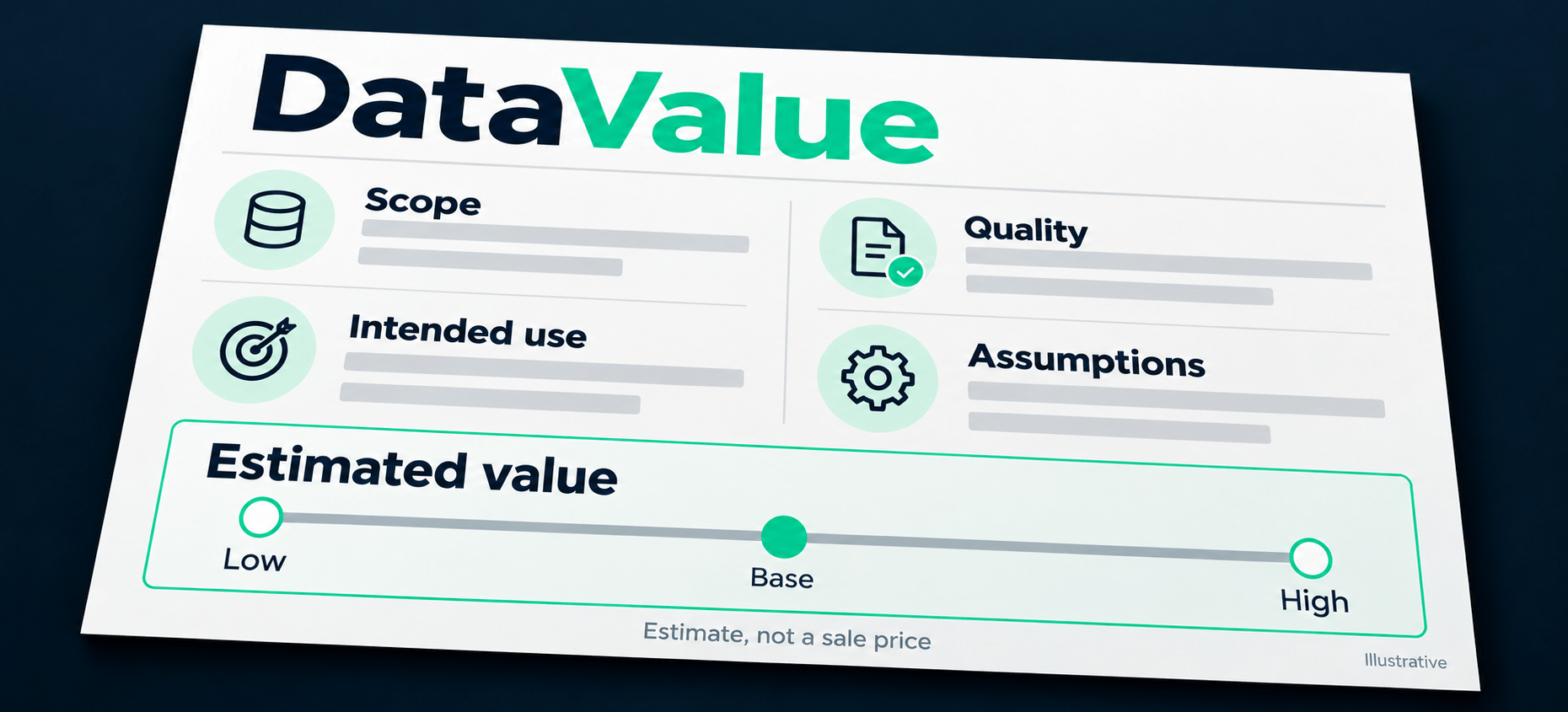
DataValue is Datavault AI's valuation engine. It has IBM watsonx.ai, IBM's platform for building and running AI models, built in, and it turns a dataset into what Datavault calls "a defensible, algorithmic dollar valuation (opens in new tab)," with a summary of the method that finance can read.
The short version: DataValue gives you an algorithmic dollar estimate for one dataset and a plain-English summary of how it was reached, so finance can test the assumptions before relying on the figure. Treat it as an estimate, not a sale price. Read beside a DataScore quality score, it shows which data to fund, fix, license, or leave alone.
What does a DataValue report give finance?
It gives finance a dollar estimate of what one dataset could be worth, produced by AI-driven valuation models, together with a summary of how that estimate was reached. The summary is what makes the number usable. Finance can see what the figure rests on, test it against what it knows, and decide how much weight to give it.
Datavault's technology overview (opens in new tab) describes DataValue as a tool that converts structured data into measurable financial value, using AI-driven valuation models to quantify the economic potential of data assets. IBM's announcement (opens in new tab) of the partnership calls it a pricing engine that assigns real-world financial valuations to enterprise data. IBM also says the expansion was meant to help customers with enterprise financial modeling, risk assessment, and pricing strategies across on-premises, cloud, and hybrid environments.
On the trial page (opens in new tab), the output is spelled out: an algorithmic valuation report with a plain-English methodology summary. What you do not get is the model itself: the scoring weights and methodology stay proprietary and patent-pending. That shapes how you review the result. You test the stated assumptions, not the code.
What makes one dataset worth more than another?
In general, data is worth more when it serves a clear use, can be trusted, may legally be used and shared, is hard to find elsewhere, is kept current, and is wanted by many users. These are general drivers of data value, not DataValue's formula, but they show what to prepare and where value can grow.
Use comes first. According to an OECD report on measuring the value of data (opens in new tab), "the value of data depends on the information it carries, as well as on its actual or potential use." The same records that barely matter for one purpose can be essential for another.
Quality matters in a less obvious way, too. The OECD calls data an "experience good": a buyer can't judge its quality until they have bought and used it. When buyers can only see average quality, they pay average prices, and the best data gets undervalued. Evidence of quality, such as a quality score, helps close that gap. The report adds that buyers need to trust the quality of the data, its legitimacy, and the reliability of its supply.
Data also gains value in combination. The OECD notes that a single data point about one person may be worth little, but combined with data about the same person over time, or about many people, it can reveal trends and patterns. That is one reason a long, consistent history can count for more than a large but patchy dump.
Here is how each driver works, and what to have ready:
| Value driver | Why it moves value | What to have ready |
|---|---|---|
| Intended use | Value depends on what the data will do | The use case and the decision it supports |
| Quality | Buyers pay less for data they can't trust | A recent quality assessment |
| Rights | You can only sell or share what you're allowed to | Consent terms, contracts, and owner sign-off |
| Uniqueness | Data that's hard to find elsewhere commands more | A note on what comparable data exists |
| Freshness | Old records lose relevance as conditions change | Update frequency and date range |
| Demand | More potential users means more potential value | Who has asked for it, inside and outside |
How should finance read a data valuation?
Read it as a reasoned estimate. Start with the methodology summary, check that the dataset and intended use in the report match the decision you face, and note the date. Then set the figure next to what the data costs to keep and what is riding on the decision. Five checks cover it.
- Scope. Is the dataset in the report the one you plan to fund, use, or license, with the same sources and date range?
- Use. Does the valuation assume the same use you have in mind? A figure for internal planning and a figure for outside licensing answer different questions.
- Assumptions. Can someone in finance restate the main assumptions from the methodology summary in their own words? If not, ask before relying on the number.
- Condition. Is there a quality assessment alongside the valuation? A figure built on weak data inherits the weakness.
- Date. When was the valuation run, and what would make it worth running again? New sources, a quality fix, changed rights, or a real buyer's offer all qualify.
If a buyer makes an offer, record it next to the estimate, not in place of it. Terms such as exclusivity can move a negotiated price either way. Our guide to data valuation methods compares the main approaches to valuing data.
What decisions can a valuation support?
A valuation earns its keep when it changes a decision. It helps finance size data budgets, gives the commercial team a reference point before licensing talks, and ranks datasets for investment so money follows the datasets worth the most. Read alongside a quality score, it also shows which data to fix first.
Datavault offers the two tools as a pair: DataScore scores a dataset's quality, trust, and compliance, and DataValue puts a dollar figure on it. Our guide to DataScore covers the quality side. One simple way to read the two results together:
| What the results show | What it suggests | A sensible next step |
|---|---|---|
| High value, strong quality | Ready to put to work | Plan a pilot or open licensing talks |
| High value, weak quality | Worth fixing before anything else | Fund the cleanup, then revalue |
| Modest value, strong quality | Useful inside, less demand outside | Use it internally and revisit later |
| Modest value, weak quality | Hard to justify more spend | Review what you keep and why |
Take a hypothetical arena-and-ticketing group with two datasets: eight seasons of ticket sales by event, section, and price tier, and two years of activity from its fan app. Suppose the ticketing history comes back high in value but weak in quality, because a renovation changed the seat maps and resale records were loaded twice. The cleanup budget now has a clear target. The fan-app data comes back in good shape, but its consent terms limit it to internal marketing, so it stays an in-house tool.
Licensing is where an estimate pays off most visibly. Say a sponsor asks to license that ticketing history. Walking in with a reasoned figure and the assumptions behind it is a far stronger position than reacting to the sponsor's first number, and fixing the seat-map and duplicate-resale problems first protects that position. When you're ready to test a deal like that in a structured way, our guide to running a data monetization pilot sets out the steps.
How do you get a valuation for one of your datasets?
Through a free trial built around one dataset you choose. Datavault's partner team reads each request itself and puts a mutual NDA in place before anything is uploaded. After a guided kickoff, you get a DataScore quality score and a DataValue valuation report for that dataset, with its methodology summary.
The request form asks for a handful of basics, including the dataset, what you want to use it for, and the date you need a decision by. The kickoff goes better with a little preparation:
- A one-paragraph description of the dataset: what it covers, how far back it goes, and how often it updates.
- The intended use: internal planning, a product, or licensing to others.
- What you know about rights: consent terms, contracts, and who owns the data.
- The decision and its date: the budget round, licensing offer, or project the number should inform.
- Your reviewers: the people in finance and risk who will read the report.
If you already work with an IBM account team, start the conversation there. Datavault AI is a Platinum IBM Partner Plus partner, DataValue is listed in the IBM Cloud catalog (opens in new tab), and watsonx.ai is built in, so the trial is aimed squarely at watsonx and IBM Cloud users. Our overview of the Datavault AI and IBM partnership has the details.
Think of the trial as a working test on one agreed dataset. Datavault runs it in its own managed environment, so there are no API keys, no self-hosted setup, and no bulk exports beyond that dataset.
Where did the number come from?
With a DataValue report, the answer to the CFO's question is on the page: a dollar estimate for a specific dataset and use, with an account of how it was reached. That turns "a strategic asset" into a line finance can plan around, challenge, and revisit.
The next step is to pick the dataset that keeps coming up in budget conversations, gather the five prep items above, and get it valued before the next review.
Request a DataScore and DataValue trial (opens in new tab)
FAQs
What should finance do with a DataValue figure?
Run five checks before relying on it: confirm the dataset and date range match your decision, confirm the use the valuation assumes, restate its main assumptions from the methodology summary, pair it with a quality assessment, and note when it should be run again.
What makes one dataset worth more than another?
In general, data is worth more when it serves a clear use, can be trusted, may legally be used and shared, is hard to find elsewhere, is kept current, and is wanted by many users.
Can finance see how DataValue reached its figure?
Yes, at the level that matters for review. Each report includes a plain-English methodology summary. The model and its weights stay with Datavault, so finance reviews the stated assumptions rather than the code.
Date
November 4, 2026
Category
Technology
 Back to Media & Insights