How to Choose a Data Monetization Platform
Most platform demos follow the same tour: a polished catalog, a revenue dashboard, a long list of integrations. What they rarely start with is the dataset you need to sell, share, or value, and the decision riding on it. Flip that order and the choice gets much easier: start with your data, score vendors on seven criteria, match the platform type to how you plan to earn, and put the same questions to every vendor.
Choosing the wrong platform costs more than a license fee. It can mean a year of payments for a marketplace your buyers never visit, or a deal that stalls in legal review because nobody tracked what the data may be used for.
The short version: Pick the platform that handles your dataset best, not the one with the best demo. Define the dataset, buyer, decision, rights, and location first, then weight seven criteria by what your first deal needs. Insist that every vendor runs your own data, not a sample, before you compare scores.
What should you decide before you look at any platform?
Decide which dataset you want to earn from, who would use it, and what decision the platform must help you make. Add what you are allowed to do with the data and where it lives today. Those five answers turn a vague software search into a short list of requirements you can test.
Write the answers down before the first demo, because every vendor will steer the conversation toward its strengths:
- The dataset. One specific dataset, not "our data." Name it, its size, and how often it updates.
- The user or buyer. Your own teams, a few known partners, or an open market of buyers you have never met.
- The decision. Set a license price, launch a data product, or prove to leadership that the data is worth investing in.
- The rights. What consent, contracts, and privacy rules allow, including whether the data can leave your company at all.
- The location. Which cloud, warehouse, or system holds the data today, and whether it can move.
If you are still deciding between using data internally and selling it, start with our guide to data monetization methods. The platform question only makes sense once the business model is clear.
Which criteria separate a good platform from an expensive mistake?
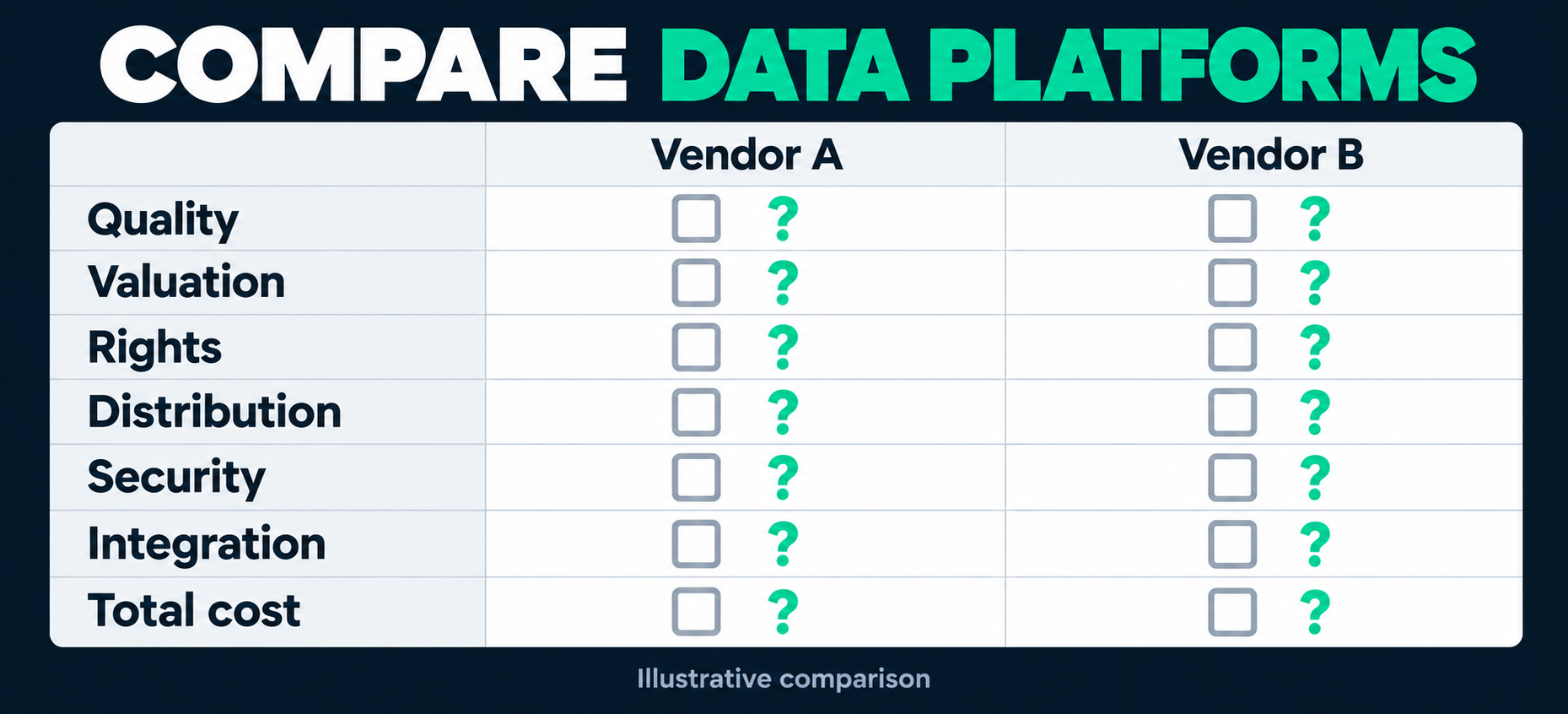
Seven criteria do most of the work: quality assessment, valuation, rights and governance, distribution, security, integration, and total cost. No platform wins on all seven. Score each vendor against your own dataset and decision, and weight the criteria by what your first deal needs.
Here is what to look for under each one:
- Quality assessment. A problem you find before listing is a fix. A problem a buyer finds after signing is a refund request. Look for checks on completeness, accuracy, consistency, and timeliness, with results you can read. If quality is left entirely to you, budget for a separate tool.
- Valuation. Ask how the platform helps you set a price, and whether finance could follow the reasoning. A number without a method is hard to defend in a negotiation. Our guide to data valuation methods explains the common approaches.
- Rights and governance. The platform should record who may access the data, for what purpose, and for how long, with an audit trail. Marketplaces cover part of this. An AWS Data Exchange (opens in new tab) grant records the receiver's account and how long access lasts, but AWS still encourages customers to do their own due diligence on data privacy laws.
- Distribution. Find out where buyers will discover your data and how they pay. On AWS, providers publish a public offer that sets prices, durations, a data subscription agreement, and a refund policy, and they can create custom offers for specific buyers.
- Security. Ask where your data is processed, who at the vendor can see it, how each access is logged, and how a buyer's access ends when a license expires. Vague answers here become your problem in a security review.
- Integration. Check where the data has to live. AWS Data Exchange supports five types of data sets: files, APIs, Amazon Redshift, Amazon S3, and AWS Lake Formation (in preview). Snowflake Marketplace (opens in new tab) shares live data with consumers without creating copies. Both work best when your data already sits in that cloud.
- Total cost. Add up platform fees, any share of each sale, storage and transfer charges in your cloud, and the hours your team will spend preparing data. Ask each vendor for a first-year cost on your dataset, plus a second figure if sales double, so you can see how a revenue share grows.
Weighting matters as much as scoring. Here is a hypothetical example. A media publisher wants to license reader-engagement data to advertisers. Its first deals depend on price and permissions, so it weights valuation and rights at 3, quality and security at 2, and distribution, integration, and cost at 1. Each vendor is scored from 1 to 5, and each cell shows the score with the weighted score in parentheses:
| Criterion (weight) | Vendor A | Vendor B |
|---|---|---|
| Valuation (3) | 1 (3) | 4 (12) |
| Rights and governance (3) | 3 (9) | 3 (9) |
| Quality assessment (2) | 3 (6) | 3 (6) |
| Security (2) | 3 (6) | 3 (6) |
| Distribution (1) | 5 (5) | 2 (2) |
| Integration (1) | 3 (3) | 3 (3) |
| Total cost (1) | 3 (3) | 3 (3) |
| Total | 21 (35) | 21 (41) |
Unweighted, the two vendors tie at 21. Weighted, Vendor B wins 41 to 35. Its 3-point lead on valuation is worth 9 weighted points, while Vendor A's 3-point lead on distribution is worth only 3. A team selling a standard feed to many small buyers would weight the other way, and Vendor A would win.
Which type of platform fits how you plan to earn from data?
Platforms fall into three broad types. Marketplaces list data products for many buyers at set prices. Exchanges support negotiated deals between known parties. Full-stack platforms also assess and price data before it is sold. The right type follows from your buyer and how much you know about your data's worth.
The names don't always help. AWS calls its service a data exchange, yet it handles both private data grants to a named account and public products listed in AWS Marketplace. Judge a platform by what it does, not what it is called.
| Platform type | Best for | Watch out for |
|---|---|---|
| Cloud data marketplace | Selling a standard data product to buyers already in that cloud | Pricing and quality checks are mostly up to you |
| Data exchange | Negotiated deals for specialized data between known parties | Fewer buyers, and terms take longer to agree |
| Full-stack platform | Teams that must assess and price data before selling it | More layers to evaluate, so test each one |
Cloud marketplaces are the right call when your data already lives there and your buyers do too. AWS Data Exchange, for example, removes the need for providers to build and maintain their own data delivery and entitlement infrastructure. Snowflake Marketplace lets providers publish free, sample, and paid listings to the Snowflake customer base.
Exchanges fit high-value data where each deal is different. Full-stack platforms make sense when the question is not "where do we list this?" but "what is this worth, and is it fit to sell?" For a closer look at the first two, read our comparison of data marketplaces and data exchanges.
What should you ask every vendor?
Ask every vendor the same questions, about your dataset, and ask them to show the answers rather than describe them. Identical questions make demos comparable. Using your own data exposes gaps that a polished sample dataset hides. If a vendor can't run your data before you sign, treat that as an answer too.
Bring this list to every demo:
- Can we run our own dataset through the platform before we commit?
- What does your quality assessment measure, and what exactly do we get back?
- How do you arrive at a value or price, and could our finance team follow the method?
- How do you record consent, license terms, and what each buyer may do with the data?
- Where will buyers find our data, and who are those buyers today?
- Does our data have to move, and if so, into which environment?
- What do we pay in total: fees, any share of sales, storage, and transfer?
- What does the audit trail show for each transaction, and who can see it?
Score the answers in a weighted grid like the publisher's. Two or three vendors scored this way will tell you more than ten feature lists.
Where does Datavault fit, and where might it not?
Datavault is a full-stack option for teams that need to know a dataset's condition and value before they sell it. For the dataset you picked, DataScore® shows what condition it is in, and DataValue® estimates what it could be worth, so you can fix gaps and set a starting price before you go to market.
DataScore's assessment lets you find weak spots in a dataset before a buyer does, and decide whether to fix them or price them in. DataValue's algorithmic estimate gives you a starting point for pricing and something concrete to discuss with finance. Both tools have IBM watsonx.ai built in, according to IBM's announcement (opens in new tab), and our guide to the IBM partnership explains what that means for IBM customers.
Once a dataset is ready, it needs somewhere to be listed. Datavault's platform (opens in new tab) covers that step with its Information Data Exchange®, and the company announced the exchange's commercial opening (opens in new tab) on September 15, 2026.
Datavault is not the answer to every case. If you sell a standard feed to buyers already inside AWS or Snowflake and you know your price, or you only want to improve your own operations, a cloud marketplace or the tools you already run may serve you better.
Which platform should you pick?
Pick the vendor that scores highest on your weighted grid after running your own dataset, not the one with the most features or the smoothest demo. A vendor that can't show its answers on your data doesn't belong on the shortlist, however good the catalog looks.
The practical next step is one page. Write your five pre-work answers and the eight vendor questions on it. Send that page to two or three vendors, at least one of each type that fits your buyer, and ask each to come back with answers for that dataset.
If you still can't say what your dataset is worth or what condition it is in, ask for a Datavault demo and put your vendor questions to the team.
Request a Datavault demo (opens in new tab)
FAQs
What is a data monetization platform?
It is software that helps an organization earn money or measurable value from data. Depending on the platform, that can mean assessing data quality, estimating value, managing access, and distributing data to buyers through a marketplace or an exchange.
Can we use more than one data monetization platform?
Yes. Some teams assess and price a dataset in one place and list it where their buyers already shop, such as a cloud data marketplace. The test is whether the pieces connect without moving the same data around repeatedly.
Do we need a platform to start earning from data?
Not always. If the goal is to improve your own operations, your existing data and analytics tools can often do the job. A platform pays off when you need to price data, control what buyers may do with it, and deliver it to outside parties. Our guide to data monetization methods explains the difference.
Date
November 12, 2026
Category
Technology
 Back to Media & Insights