Data Marketplace vs. Data Exchange: Which Fits Your Data?
You have a dataset other companies want to buy. Do you list it where any buyer can find it, or sell it only to buyers you pick, on terms you agree one deal at a time? Knowing how a data marketplace and a data exchange differ tells you which route suits that dataset, what each one asks of your team, and what to prepare before the first sale.
Take a hypothetical regional bank that holds aggregated, anonymized card-spending trends by region and merchant category. A retail chain wants the data to plan new stores. A commercial property investor wants it to judge which shopping districts are growing. Both are reasonable buyers, but they want different slices, and some slices are more sensitive than others.
Choosing the wrong route has a cost. Put sensitive data on one public set of terms and it can reach buyers you never vetted, for uses you never approved. Sell standard data one negotiated deal at a time and your team spends weeks on contracts that a single listing could have handled. The choice comes down to reach or control.
The short version: A data marketplace lists your dataset once, on terms that apply to every buyer, so many buyers can find and subscribe to it. A data exchange sells to buyers you choose, on terms agreed deal by deal. List standard data with broad demand; keep sensitive or high-value data in direct deals. One dataset can use both, one version per channel.
What is a data marketplace?
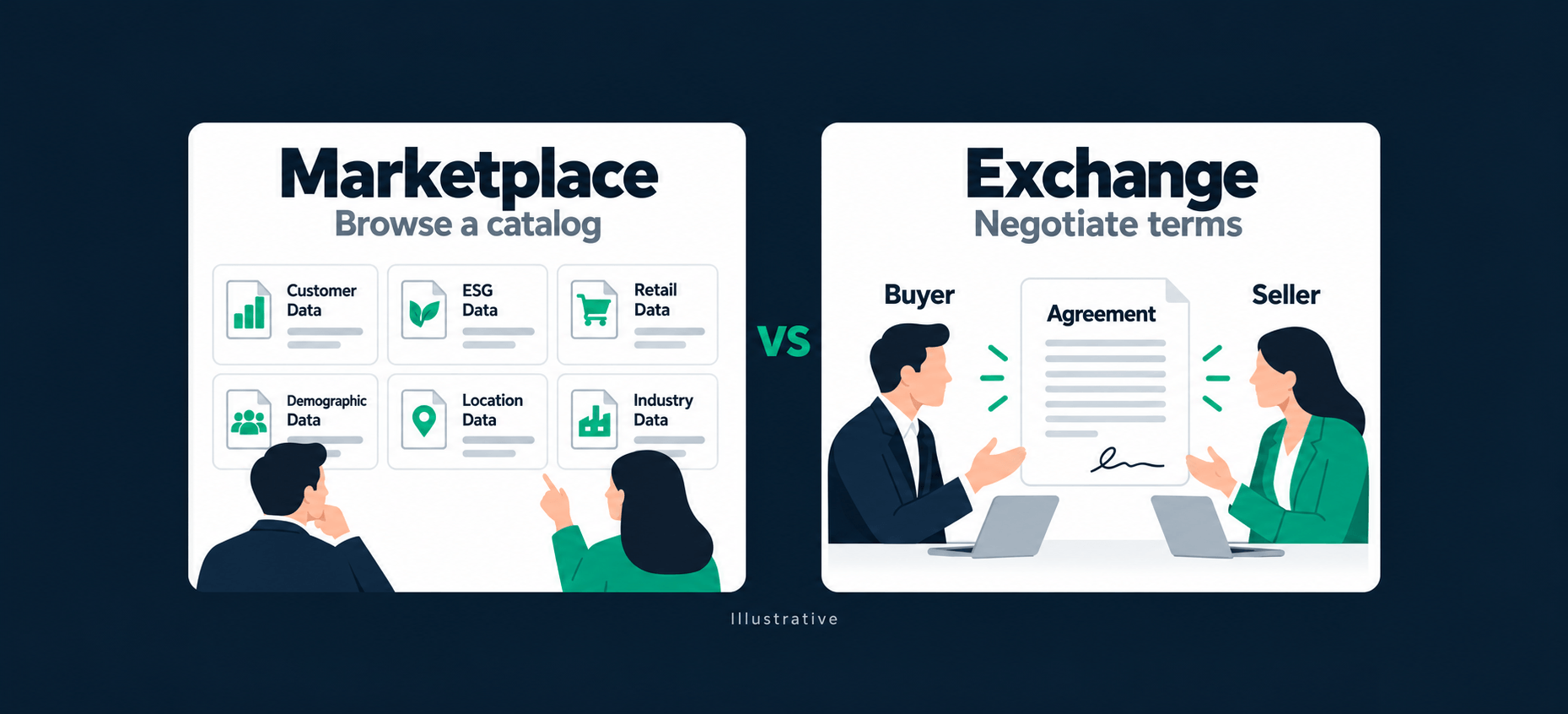
A data marketplace is a catalog where sellers list data products and buyers find, compare, and subscribe to them. The seller sets the price and terms once, and the platform handles discovery, billing, and delivery. It works like an online store: one listing, many possible buyers, little negotiation.
AWS Marketplace is a clear example. According to the AWS Data Exchange user guide (opens in new tab), a provider's data product appears in the AWS Marketplace catalog after AWS reviews it against its guidelines and terms. To list publicly, the provider defines a public offer with prices and durations, a data subscription agreement, and a refund policy, with the option to create custom offers. Buyers can receive the data as files, through an API, or through Amazon Redshift, Amazon S3, or AWS Lake Formation, which is in preview.
Snowflake Marketplace (opens in new tab) offers the same kind of catalog to companies on Snowflake. Its documentation says providers can share curated data offerings with many consumers at once and share live data without creating copies. Listings can be free, paid, or offered as samples. Both platforms handle delivery and access, so you don't build data pipelines or entitlement systems yourself.
What is a data exchange?
A data exchange is a way of sharing or selling data directly between known parties, with terms agreed for each deal. You decide who gets access, what they may do with the data, for how long, and at what price. It is closer to a negotiated contract than a shelf in a store.
Exchanges take different forms, and the same vendor often runs both models. Snowflake also offers a Data Exchange (opens in new tab), which its documentation describes as "a data hub for securely collaborating around data with a selected group of members that you invite." Providers publish data that only those invited members can discover. It isn't enabled for every Snowflake account, so you may need to ask Snowflake to turn it on.
AWS works in a similar way. Besides its marketplace catalog, AWS Data Exchange lets a sender share data directly through data grants, which give one named AWS account access to a data set for a set period, with no public listing. A grant sets out the data and the length of access, not a price, so the commercial terms of a direct deal sit in your own agreement with the buyer.
Direct deals let you approve each buyer, price by how they will use the data, and write limits on that use into the contract. That matters most for data with strings attached. If consent, contracts, or privacy rules restrict who may use a dataset, a contract per buyer is how you keep those promises.
How do a marketplace and an exchange compare?
They differ on who sets the terms and how many buyers you can serve. A marketplace sets terms once for many buyers and handles billing and delivery. An exchange sets terms per deal with a few chosen buyers and leaves more of the work to you. The table compares them on the points that decide a sale.
| Dimension | Data marketplace | Data exchange |
|---|---|---|
| Who buys | Anyone on the platform who finds the listing | Buyers you choose or approve |
| How buyers find you | Search and browsing in a catalog | Your outreach, referrals, or invitations |
| Pricing | Published once, same for most buyers | Agreed deal by deal |
| Terms of use | One standard agreement | Written for each buyer and use |
| Governance after the sale | The listing's standard terms | Use limits, audits, and renewals in each contract |
| Billing and delivery | Handled by the platform | Arranged by you or the exchange |
| Effort per sale | Low once the listing is live | Higher, since each deal is negotiated |
| Best for | Standard data with broad demand | Sensitive, high-value, or custom data |
Which one fits your data?
Pick a marketplace when your data is standardized, useful to many companies, and safe to license to all of them on the same terms. Pick an exchange when the data is sensitive, valuable to a few specific buyers, or limited by consent and contracts. When one dataset has both qualities, split it and use each channel for its part.
These questions usually decide it:
- Who would buy it? If you can name the buyers, direct deals may be enough. If you can't, a catalog helps them find you.
- Is it standard or custom? Data that many buyers use the same way suits one listing. Data that each buyer needs cut differently suits separate deals.
- What are you allowed to do with it? Consent and contracts may limit sharing to certain buyers or uses. Those limits are easier to hold in a negotiated contract than in a public listing.
- How sensitive is it? The more harm misuse could cause your customers or your business, the more you want to approve each buyer yourself.
- Do you know what it's worth? A marketplace asks you to publish one price. An exchange lets the price follow each buyer's use, but you still need a reference point. Our guide to data valuation methods explains the options.
Back to the hypothetical bank. Spending trends by region and merchant category are anonymized, standard, and useful to many buyers, so a marketplace listing suits them: the retail chain and the property investor can both subscribe on the same terms. Merchant-level detail is different. Even without customer names, it could expose how individual businesses are doing, so it stays in direct deals with a few vetted buyers and clear limits on use.
If you're comparing specific tools for either route, our guide to choosing a data monetization platform covers the criteria.
What should you have ready before you sell either way?
Whichever route you take, buyers will ask the same things: do you have the right to sell this, how good is it, what does it cost, how is it delivered, and what may they do with it. Write those answers down before you list or negotiate. They shape both the price and how quickly a sale can close.
- Rights. Confirm that consent, contracts, and privacy rules allow the sale and the uses you plan to permit.
- Quality evidence. Buyers pay for data they can trust. Be ready to show how complete, accurate, and current it is.
- A price reference. Know roughly what the data is worth before you name a price or accept an offer. A valuation report, such as one from DataValue, gives you a starting point. It is an estimate, not a sale price, but it beats guessing.
- Delivery. Decide how buyers get the data: files, an API, or live access inside their cloud platform.
- Terms. Write the license: permitted uses, duration, refunds, and what happens when the contract ends. AWS requires a data subscription agreement and a refund policy in every public offer, which makes a useful checklist even if you sell elsewhere.
- Support. Name who answers buyer questions and fixes problems after the sale.
Selling isn't the only way to make data pay, and sometimes it isn't the best one. If you haven't yet weighed putting the data to work inside your own business, our data monetization guide lays out those options next to selling.
What does Datavault's Information Data Exchange add?
Datavault's Information Data Exchange® is a marketplace built around scoring and valuation. Datavault describes it as a marketplace for the secure valuation, scoring, tokenization, and monetization of data and real-world assets. For a seller, that means a listing's price can rest on a quality score and a valuation instead of a hunch.
In its September 15, 2026 announcement (opens in new tab) of IDE's commercial opening, Datavault names the two tools behind that work: DataScore® assesses a dataset's quality and attributes, and DataValue® establishes its economic value. The same announcement says the architecture is designed to do this without moving, ingesting, storing, or altering the customer's original dataset. For sensitive data, that design is worth knowing about before you share anything.
DataScore and DataValue can also be used on their own, before you decide whether to list a dataset at all. A quality score and a valuation are useful whichever route you choose. You can see the full product set on the Datavault platform page (opens in new tab).
IDE suits sellers who want buyers to find their data without setting a price blind. If you're sharing one dataset with one partner you already know, a direct agreement may be simpler.
Marketplace, exchange, or both?
If you can't name your buyers, list the data on a marketplace. If you can name them, and the data would hurt you or your customers in the wrong hands, sell it deal by deal. If both are true for different parts of a dataset, split it and use each route for its part.
Start with one dataset and the questions above, beginning with who would buy it and what it might be worth. To see scoring, valuation, and listing work together, ask the Datavault team for a demo.
Request a Datavault demo (opens in new tab)
FAQs
Is AWS Data Exchange a marketplace or an exchange?
Both. Providers can list data products in the public AWS Marketplace catalog, where buyers subscribe on the provider's published terms. AWS Data Exchange also supports data grants, in which a sender gives a specific AWS account access to a data set for a set period, without a public listing.
Can I use a marketplace and an exchange at the same time?
Yes. You might list a standard version of a dataset on a marketplace and sell a more detailed or sensitive version through direct deals. Check that the two sets of terms don't conflict, for example by promising one buyer exclusive rights to data you also list publicly.
Do I need to know what my data is worth before I sell it?
It helps a great deal. A marketplace asks you to publish one price, and an exchange needs a starting point for each negotiation. Cost-based, market-based, and income-based methods each give a different reference, and using more than one gives you a range to work from.
Date
November 8, 2026
Category
Technology
 Back to Media & Insights