watsonx.governance: The Evidence Data Buyers Want
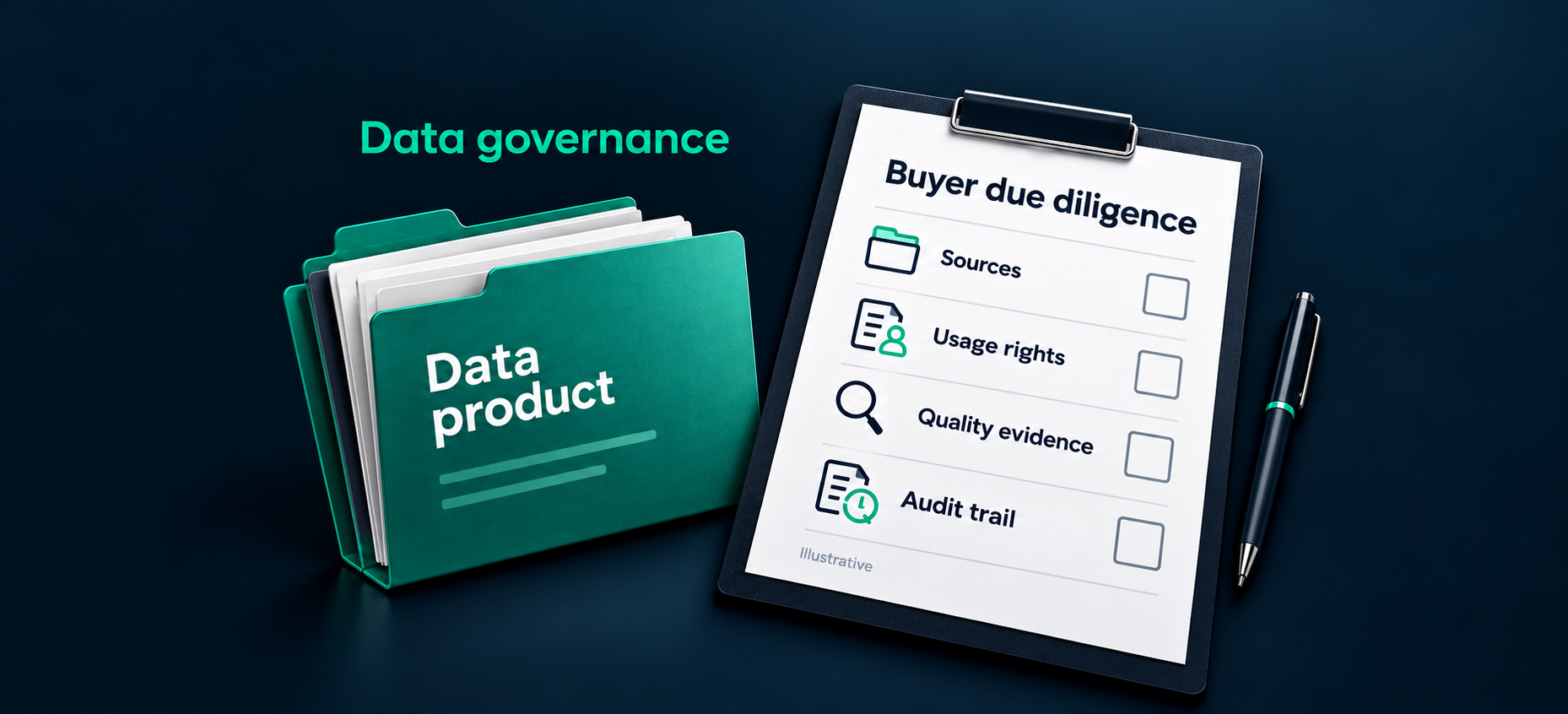
Picture a hypothetical deal: you run data products at a telecom operator, and a buyer wants to license five years of aggregated location trends from your network. The scope is agreed, and then their risk team sends a governance questionnaire. Below are the questions it will ask, the documents that answer each one, and where IBM watsonx.governance and Datavault AI's DataScore help you produce them.
Few of those questions are about price. Where did this data come from? What rights cover it? What has been done to it since? How good is it, and how will anyone know if something goes wrong? Answer with documents and the deal keeps moving. Answer with reassurances and it waits.
The same records also make your data safe to feed into your own AI, so the work pays off twice.
The short version: Expect a buyer's risk team to ask for documents on each dataset: its source, the rights that cover it, quality results, and a named owner, plus records for any model built on it. IBM watsonx.governance can keep the model records. Datavault AI's DataScore supplies quality evidence. Rights and consent records have to come from you.
Why do buyers ask about governance before they talk price?
Because when they buy your data, they also buy its risks. If the data was collected without the right consent, carries someone else's intellectual property, or hides quality problems, those become the buyer's problems the moment they build on it. Governance evidence is how they check before they sign.
Regulators enforce this, and location data is a sharp example. In April 2024 the Federal Communications Commission (opens in new tab) fined AT&T, Sprint, T-Mobile, and Verizon nearly $200 million for sharing access to customers' location data without consent. The FCC found that each carrier had tried to offload its obligation to obtain consent onto the companies downstream. A buyer reading that will want your consent records before they want your price.
Risk frameworks point the same way. The US National Institute of Standards and Technology's AI Risk Management Framework (opens in new tab), a voluntary framework released in January 2023, warns that third-party data can complicate risk measurement. The framework turns that into a policy expectation: its GOVERN 6.1 practice calls for policies that address risks from third parties, including the risk of infringing someone else's intellectual property or other rights.
IBM already works this way. According to the Data & Trust Alliance (opens in new tab), IBM tested a set of data provenance standards in early 2024 as part of its clearance process for datasets used to train foundation models, and saw improvements in both the time clearance took and overall data quality.
What will a buyer's governance questionnaire ask?
Most questions fall into six groups: where the data came from, whether you have the right to use and share it, what has been done to it, how good it is, how any AI built on it is governed, and how problems will be caught. Each group needs a document you can hand over.
Here is how each question maps to what a buyer will want to see:
| What the buyer asks | What to hand over | Where it comes from |
|---|---|---|
| Where did this data come from? | Source, collection method, dates covered | Your data catalog and provenance records |
| Are we allowed to use it this way? | License terms, consent records, intended use | Contracts, consent logs, legal review |
| What has been done to it? | A record of each transformation and merge | Pipeline logs and lineage tools |
| How good is it? | Quality results against named measures | Data quality checks and a DataScore assessment |
| How is AI built on it governed? | Model purpose, risk ratings, approvals | AI factsheets in a governance tool |
| How will problems be caught? | Refresh schedule, correction process, contact | Your monitoring plan and support terms |
The last row is the easiest to overlook. NIST's GOVERN 6.2 practice asks for contingency processes to handle failures or incidents in third-party data or AI systems deemed high-risk. For a seller, that means three commitments in writing: how often the data refreshes, how buyers hear about a correction or a withdrawn consent, and who they call when something looks wrong.
The rights question deserves the most care. A dataset can be accurate, complete, and well documented and still be unsellable if part of it came from a supplier whose license forbids resale.
What evidence should you prepare before the questionnaire arrives?
Prepare one governance file for each dataset you plan to sell or use in AI. It should record the data's source and history, the rights and consents that cover it, the quality checks it passed, and the person accountable for it. Keep it current, because a buyer will check that the file matches the data they receive.
You don't have to invent the format. The Data & Trust Alliance's Data Provenance Standards (opens in new tab), version 1.0.0 from July 2024, give you a ready-made checklist of 22 metadata fields in three groups. They were co-developed by 19 member organizations, and IBM is among the companies involved.
- Source: the dataset's name, a unique identifier, who issued it, where its metadata lives, and a description.
- Provenance: where and when the data was generated, the range of dates it covers, how it was collected, and its format.
- Use: its confidentiality level, where the consent documentation lives, any privacy protections applied, where it may be processed and stored, the license, the intended use, and whether it contains proprietary data.
Add two things the provenance fields leave out. The first is quality evidence: the checks the data passed and their results. The second is an owner, the person who answers for the dataset, approves changes to it, and signs off on each new buyer.
Then write down what the buyer may do with the data. A short use statement (the purposes allowed, whether the buyer may combine it with other data, and whether it may train a model) heads off follow-up questions and keeps every contract on the same terms.
Back to the hypothetical deal. The operator's file shows the location trends come from its own network records, cover 2021 through 2025, and were produced under consent terms that allow aggregated, de-identified analysis. The use statement rules out any attempt to trace individual subscribers. Those two lines shape the whole offer, and they are the first thing the buyer's legal team checks. If you are scoping a first sale like this, our pilot guide shows how to set one up.
What does IBM watsonx.governance do?
watsonx.governance is IBM's product for governing AI systems across their lifecycle, sold by IBM separately from Datavault AI's tools. For a data seller, its value lies in the records it keeps about models built on your data, so the AI questions on a buyer's questionnaire get answers that were captured while the work happened.
On its product page (opens in new tab), IBM describes a governance graph that maps the relationships between AI systems, risks, controls, and policies. It lists automated policy enforcement, obligation mapping, and compliance evidence capture; continuous monitoring for compliance, operational issues, and emerging risks; and AI risk management throughout the lifecycle.
The piece most sellers will meet first is the AI factsheet. According to IBM's documentation (opens in new tab), AI Factsheets record a model's purpose and criticality, the measured characteristics of its data and the model itself, and the lineage of events and actions as the model is created and deployed.
That is where your file meets the buyer's tools. In the telecom example, if the buyer trains a model on your location trends, its factsheet asks for the measured characteristics of the data. Your governance file and your DataScore results fill that in.
One limit is worth knowing before you buy. watsonx.governance governs AI systems; it cannot create provenance or consent records your organization never kept. That part of the file starts with you.
How does a DataScore assessment add evidence about the data?
DataScore assesses one dataset and gives you a quality and credibility score to put in its governance file. Datavault's technology overview (opens in new tab) says it analyzes multiple attributes of the data and produces standardized scores, so the same method stands behind every result a buyer reads.
File the result as the quality exhibit for that dataset. Then use it before anyone else does: fix the weak spots it points to, re-run the assessment, and hand the buyer a file that already answers the "how good is it?" row.
Datavault's trial page (opens in new tab) says DataScore scores the quality, trust, and compliance of your data. Treat that as evidence for the file. Your legal and privacy teams still decide whether a given use is allowed.
So two vendors cover different rows of the questionnaire: IBM's watsonx.governance documents the models, and Datavault AI's DataScore, which runs on IBM watsonx.ai, assesses the data that feeds them. IBM's announcement (opens in new tab) describes DataScore as an AI-driven scoring and risk analysis tool that assesses data quality.
Our DataScore guide explains how to read the results, and the AI data readiness checklist covers the rest of the preparation for AI use. When the talk turns from "can we trust it?" to "what is it worth?", DataValue's valuation report, which comes with a short, readable account of how the number was reached, supports that conversation. Our guide to the Datavault AI and IBM partnership covers both tools.
Where should your governance file start?
Start with the dataset closest to a sale or an AI launch, and build its file: source, provenance, rights and consent, quality evidence, a use statement, and an owner. The gaps you find become your to-do list. Close the rights gaps first, because no amount of quality work can make data you aren't allowed to sell sellable.
For the quality row, you have help. Send one dataset you plan to license. You get a quality assessment to file and a valuation for the price talk, with an NDA signed before any data moves. The trial suits teams on IBM Cloud and watsonx best.
Request a DataScore and DataValue trial (opens in new tab)
FAQs
Is watsonx.governance part of Datavault AI's products?
No. watsonx.governance is IBM's AI governance product, sold by IBM. Datavault AI embeds a different IBM product, watsonx.ai, in its DataScore and DataValue tools. The two cover different questions: watsonx.governance documents and monitors AI systems, while DataScore assesses a dataset.
What is data provenance, and why do buyers ask for it?
Data provenance is the record of where data came from, how it was created, and how it may be used. Buyers ask for it because they inherit the data's risks, including consent and intellectual property problems. The Data & Trust Alliance's standards define 22 provenance fields that make a good starting checklist.
Do you need governance software before you can sell data?
No. You can start with a governance file for each dataset, kept in whatever system your team already uses. Software such as watsonx.governance helps once you have many AI systems to track and want evidence captured as the work happens.
Date
November 10, 2026
Category
Technology
 Back to Media & Insights