
Data Monetization Pilot: A 90-Day Plan for IBM Teams
The request usually arrives as one line in a planning meeting: show us that our data can make money, and show us by next quarter. No new team comes with it, and no year-long program. Here is a 90-day plan that answers it, covering what to do in each phase, who owns each step, how to judge the result, and where Datavault AI's free trial fits.
The risk is a pilot that ends with a slide about potential and no figure anyone can act on. A July 2026 research briefing (opens in new tab) from MIT's Center for Information Systems Research names the habit behind that outcome: organizations "frequently forget to go after the money, assuming it will show up on its own."
The short version: A data monetization pilot shows, in about 90 days, whether one dataset can earn money. Pick the data and a dated decision, clear the rights, score its condition, estimate its value, and test demand. Success is a go, fix, or stop call tied to a budget line, not a sale. Datavault AI's free trial handles the scoring and valuation.
Why run a pilot instead of a full data monetization program?
A pilot answers the question leadership is asking without betting a budget cycle on it. A single dataset and a single decision take weeks, not years. You learn whether the data is usable, what it might be worth, and whether anyone wants it before you commit to new platforms, hires, or a multiyear plan.
IBM's own guidance starts the same way. Its data monetization strategy overview (opens in new tab) recommends a discovery workshop to choose "your first data product," followed by a 4 to 6-week sprint to build a proof of concept for it. From there, IBM's process moves to the initial product, a roadmap, and a business case.
A pilot can test either kind of value. IBM's overview separates internal monetization, where data is shared across functions or business units, from external monetization, where it is shared with other organizations for strategic and financial gain. Your pilot can aim at a business unit that would pay for better data or at an outside buyer. If you are still weighing those routes, our guide to data monetization methods compares them.
How do you choose the right dataset and decision?
Pick data you clearly control and a decision with a date. The best first candidate is data your team knows well, has the rights to use, and that someone has already asked about. The decision gives the pilot its finish line: license the data, build on it, fix it, or drop it.
Look for these four things in a first dataset:
- Clear rights. You collected it, consent covers the intended use, and no contract stops you from sharing it.
- A demand signal. A partner asked for it, a business unit keeps requesting it, or an AI project depends on it.
- A named owner. One person can explain where the data comes from and what each field means.
- A manageable size. Big enough to matter, small enough to prepare in two weeks.
The decision matters as much as the data. "Explore monetization" is not a decision. "Decide before the June partner renewal whether to offer a load-pattern product" is.
Take a hypothetical regional utility with five years of smart-meter interval data. An energy-services partner has asked whether it could buy aggregated load patterns by neighborhood, and the partner's contract renews in June. Before anything else, the pilot needs one answer: do the utility's customer agreements and privacy obligations allow it to sell aggregated load patterns at all? If they do, the pilot has its data, a buyer signal, and a dated decision. If you want a fuller checklist before you start, the setup questions in our guide to what your data is worth cover rights, quality, and documentation.
What happens in each phase of a 90-day pilot?
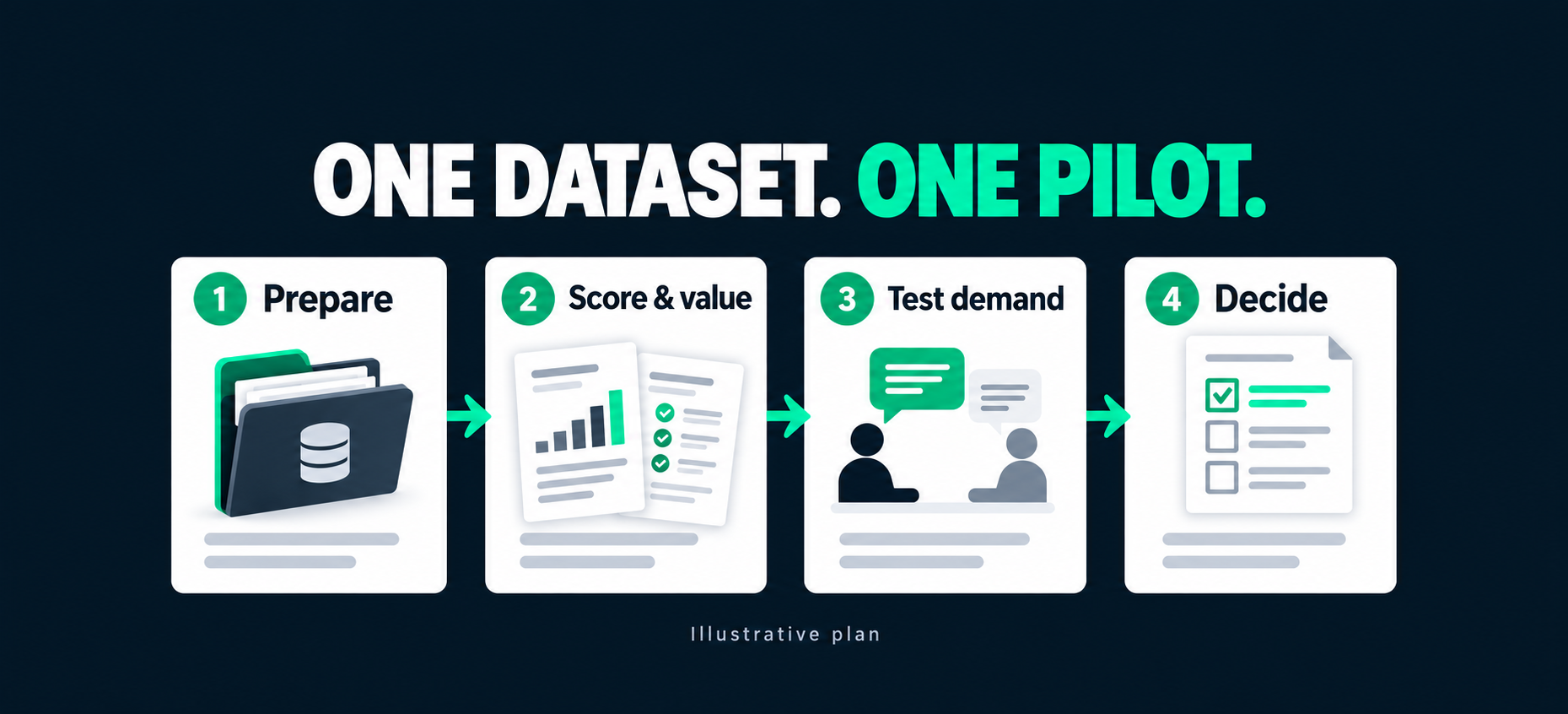
The pilot runs in five phases over about 12 weeks: set up, score the data's condition, estimate its value, test demand, and decide. Each phase produces one output the next phase needs. That structure also lets you stop early if the data fails a check, which saves the remaining weeks for a better candidate.
The timings below are our planning guide, not a Datavault service schedule. Adjust them to your data and your deadline.
| Weeks | Phase | Output |
|---|---|---|
| 1 to 2 | Set up: dataset, decision, rights, trial request | A one-page charter and a decision rule |
| 3 to 4 | Score the data's condition | A quality and credibility read, plus known gaps |
| 5 to 6 | Estimate the value | A valuation with its method explained |
| 7 to 10 | Test demand | A log of requests, questions, and commitments |
| 11 to 12 | Decide | A go, fix, or stop call tied to a budget line |
Set up (weeks 1 to 2). Write the charter on one page: the dataset, the decision, the owner, and the date. Settle the rights question first; for the utility, that means legal reading the customer agreements before anyone extracts a file. Send the trial request in week 1 as well. Datavault's fit check and the mutual NDA both come before any data is shared, so starting early means the scoring phase can begin on time. Much of what the request form asks for, including your use case and the date you need a decision, is already in your charter.
Score (weeks 3 to 4). You need to know what condition the data is in before anyone prices it. DataScore® gives the submitted dataset a live quality and credibility score, as Datavault's trial page (opens in new tab) describes it. For the utility, the practical questions are how many intervals are missing and whether meter replacements broke the series. If serious gaps turn up, fix them or switch datasets now. Our DataScore guide explains how to read the results.
Value (weeks 5 to 6). DataValue® produces an algorithmic valuation report with a methodology summary in plain English. Walk your finance partner through that summary before the figure goes in front of anyone outside the team. A number finance has already questioned is much easier to defend in the final meeting. Our guide to data valuation methods covers the general approaches.
Test demand (weeks 7 to 10). This step is easy to leave vague, so make it concrete. The utility might share a sample of aggregated, anonymized load patterns under NDA with the partner and two or three other energy-services firms, then log who asks for more, what they would use it for, and whether price comes up. For an internal buyer, ask the business unit to commit budget or a start date. If the evidence points to an outside sale, Datavault announced on September 15, 2026 (opens in new tab) the commercial opening of its Information Data Exchange®, which it describes as a marketplace for the secure valuation, scoring, tokenization, and monetization of data and real-world assets.
Decide (weeks 11 to 12). Put the evidence on one page and apply the decision rule you agreed in week 1: go, fix, or stop.
Who needs to be on the pilot team?
Five or six people are enough. You need an executive sponsor who owns the decision, a data owner who knows the dataset, an analyst or engineer to prepare it, someone from legal or privacy to confirm rights, and a finance partner to test the valuation. External pilots also need someone to run buyer conversations.
MIT CISR's research is direct about why the data team cannot do this alone: "No organization can monetize its data at scale with just its data team." It takes the people who know the organization's processes, systems, and offerings.
Here is how the work splits:
- Executive sponsor: sets the decision and the date, clears blockers, and signs off on the result.
- Data owner: explains the data, answers questions, and owns fixes. The trial request asks you to name a champion, and the data owner is often the best choice.
- Analyst or data engineer: extracts the data, documents fields, and closes gaps the score reveals.
- Legal or privacy lead: confirms consent and contracts allow the intended use and manages the NDA.
- Finance partner: reviews the valuation's assumptions and names the budget line the result will affect.
- Partnerships or business lead: runs demand conversations with outside buyers or internal teams.
One person can hold two roles on a small team. What matters is that every role has a name before week one ends.
How do you know whether the pilot worked?
Judge the pilot by whether it produced a decision you can defend, not by whether it closed a sale. A good result is a clear go, fix, or stop, backed by a quality read, a value estimate finance accepts, real evidence of demand, and a link to a specific line in the budget.
That last link is the one teams skip. MIT CISR's briefing calls measurement "a core activity that separates a real return from applause": routinely tracing created value to a specific line item on the income statement. One leader in its research called that discipline the "antidote to AI theater." Build it into your scorecard from the start:
| Measure | What good looks like | How to check |
|---|---|---|
| Data condition | Gaps are known and fixed or priced in | DataScore results reviewed with risk |
| Value estimate | Finance accepts the method and assumptions | Methodology summary walked through |
| Demand | Named buyers or teams asked for more | Log of samples, questions, commitments |
| Rights | The intended use is cleared | Written sign-off from legal or privacy |
| Money link | Expected value tied to a line item | Finance names the line |
| Decision | Go, fix, or stop agreed on time | Dated decision memo from the sponsor |
Agree the decision rule in week 1, before any results arrive. For example: go if the rights are cleared, finance accepts the valuation method, and at least two named buyers ask for a sample; fix if demand is there but rights or quality need work; stop if nobody asks for more by week 10. Writing the rule down early keeps a promising number from bending the call.
A clear stop counts as success. It frees the budget for a better candidate and shows the team what a strong one looks like next time.
How does Datavault AI's free trial fit into the pilot?
The trial handles the scoring and valuation phases. Send the request in week 1: Datavault's partner team checks the fit and signs a mutual NDA with you before you hand over any data. You then receive a DataScore quality and credibility score and a DataValue valuation report with its methodology summary.
According to IBM's announcement (opens in new tab), watsonx.ai is built into both tools, and the trial page names watsonx and IBM Cloud accounts as the best fit. That makes the trial a natural first step for teams that already work in IBM's stack.
The scope is built for answers rather than plumbing. Datavault hosts the evaluation, and it does not include API keys, a self-hosted deployment, or bulk exports beyond the dataset you agreed on. A pilot needs exactly that: a scored, valued dataset and enough evidence to decide, without an integration project in the middle of the quarter.
Can you prove your data makes money in one quarter?
You can prove whether a single dataset can, and that is the honest version of the question leadership asked. A focused pilot replaces "our data is valuable" with a condition score, a value estimate, evidence of demand, and a dated decision. The next step fits on one page.
This week, write the charter: the dataset, the decision, the owner, the date, and the rule you will use to decide. Then send the trial request, so the scoring and valuation are ready when your team needs them.
Request a DataScore and DataValue trial (opens in new tab)
FAQs
How long should a data monetization pilot take?
Plan for about a quarter. IBM's guidance proposes a 4 to 6-week sprint to build a proof of concept for a first data product. The plan in this article adds time to test demand and make the decision, which brings it to roughly 12 weeks.
Does a data monetization pilot have to end in a sale?
No. A pilot succeeds when it produces a decision you can defend: go, fix, or stop. That call should rest on the data's condition, a value estimate finance accepts, evidence of demand, and a link to a specific budget line.
What does Datavault AI's free trial include?
The trial runs DataScore and DataValue on the dataset you choose. You receive a quality and credibility score and an algorithmic valuation report with a methodology summary in plain English. Datavault's partner team reviews each request and signs a mutual NDA with you before any data is shared.
Date
November 14, 2026
Category
Technology
 Back to Media & Insights